
Table of contents
- 01Treating AI Output as Application Data
- 02How Structured Outputs Work
- 03What Is JSON Schema?
- 04JSON Schema Example
- 05Why JSON Schema Matters More for AI Agents
- 06Structured Output vs “Return JSON”
- 07JSON Mode vs Structured Outputs
- 08The AI Agent Reliability Problem
- 09The Structured Output Pipeline
- 10The Three Validation Layers
- 11Designing Good Schemas
- 12Structured Outputs in Multi-Step Agents
- 13Tool Calling with Validation
- 14Multi-Agent Schema Contracts
- 15Human Approval Gate
- 16Security Layers
- 17Schema Versioning
- 18Monitoring & Observability
- 19Best Practices Checklist
- 20Core AI Infrastructure
Treating AI Output as Application Data
Production-grade AI agents do not just chat; they perform actions. They call tools, execute database queries, and generate complex user interfaces. In 2026, the industry has standardized on the principle that the model's output is not "content" to be displayed, but "data" to be processed. This shift requires a rigorous contract between the LLM and the application logic, ensuring that every generated byte conforms to the expected types and constraints of the downstream system.
When an agent operates autonomously, it becomes the primary user of your internal APIs. If that agent provides malformed data, your system must catch it before it causes side effects. By treating AI output as structured application data, we can apply standard software engineering practices—like unit testing, type checking, and schema validation—to the otherwise unpredictable world of generative AI.
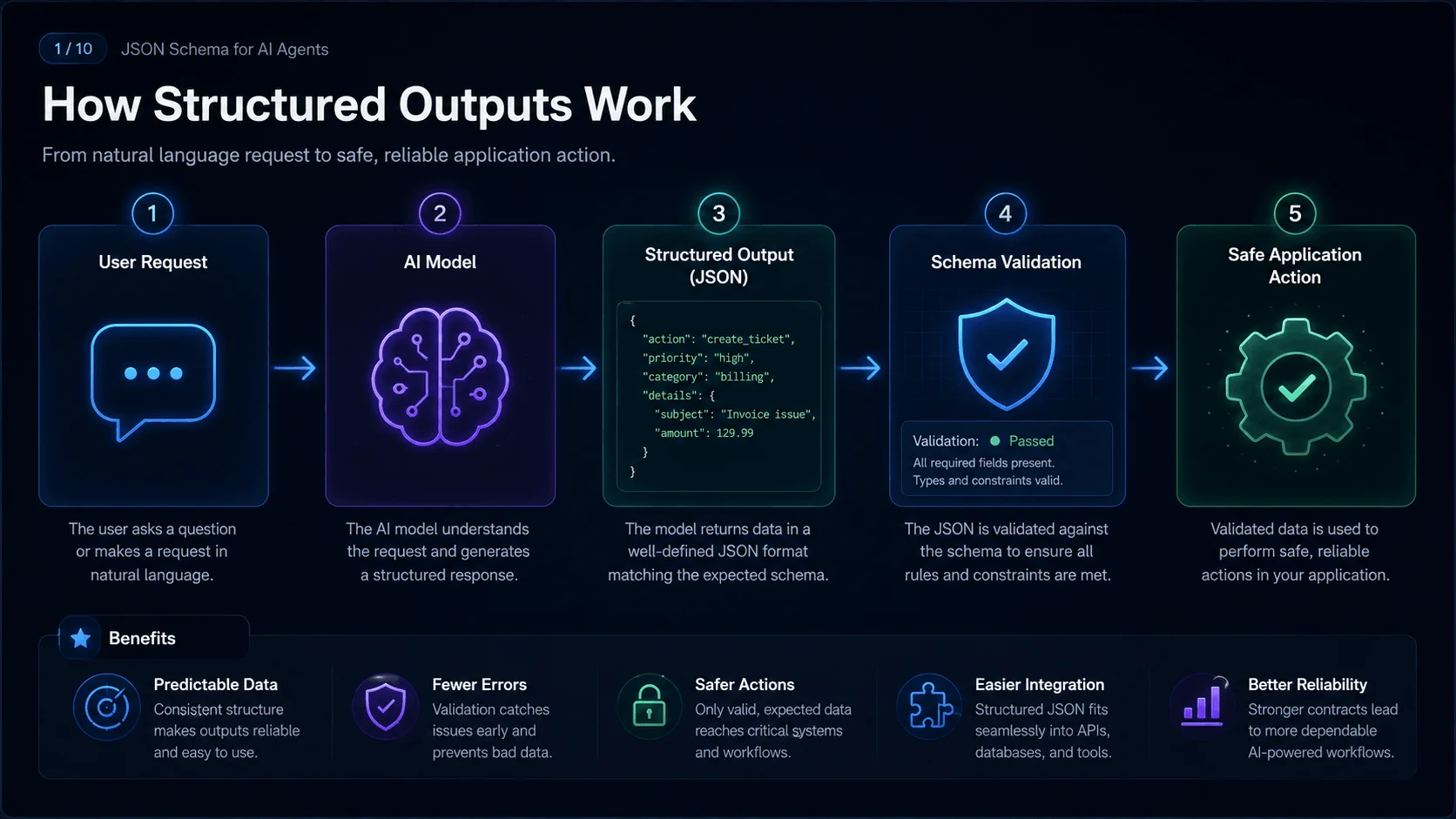
How Structured Outputs Work
Structured output is the mechanism by which an AI model is constrained to return data that follows a specific, machine-readable format. Instead of the model simply "trying its best" to format a string as JSON, modern inference engines use techniques like constrained decoding and logit bias to ensure the model literally cannot output a character that violates the provided schema. This provides a mathematical guarantee that the syntax will be correct every single time.
Beyond simple syntax, structured output systems allow developers to define deep nested structures, required fields, and specific value ranges. This level of control is what enables multi-step agentic workflows, where the output of one step becomes the input for the next. Without this strict enforcement, errors would compound rapidly, leading to the "hallucination cascade" that often plagues less sophisticated AI implementations.
What Is JSON Schema?
JSON Schema is the industry-standard, machine-readable vocabulary for describing the expected structure of JSON data. It allows developers to define a "contract" that specifies which fields are required, which data types (string, number, boolean) are acceptable, and what patterns the data must follow. In the context of AI agents, JSON Schema acts as the blueprint that the model must follow when generating its response.
A well-defined schema serves two purposes: it tells the model exactly what to generate, and it tells the application exactly how to validate what was received. This dual-purpose nature is why JSON Schema has become the go-to choice for AI tool calling and structured output enforcement. It provides a common language that both human developers and AI models can understand and follow with high precision.
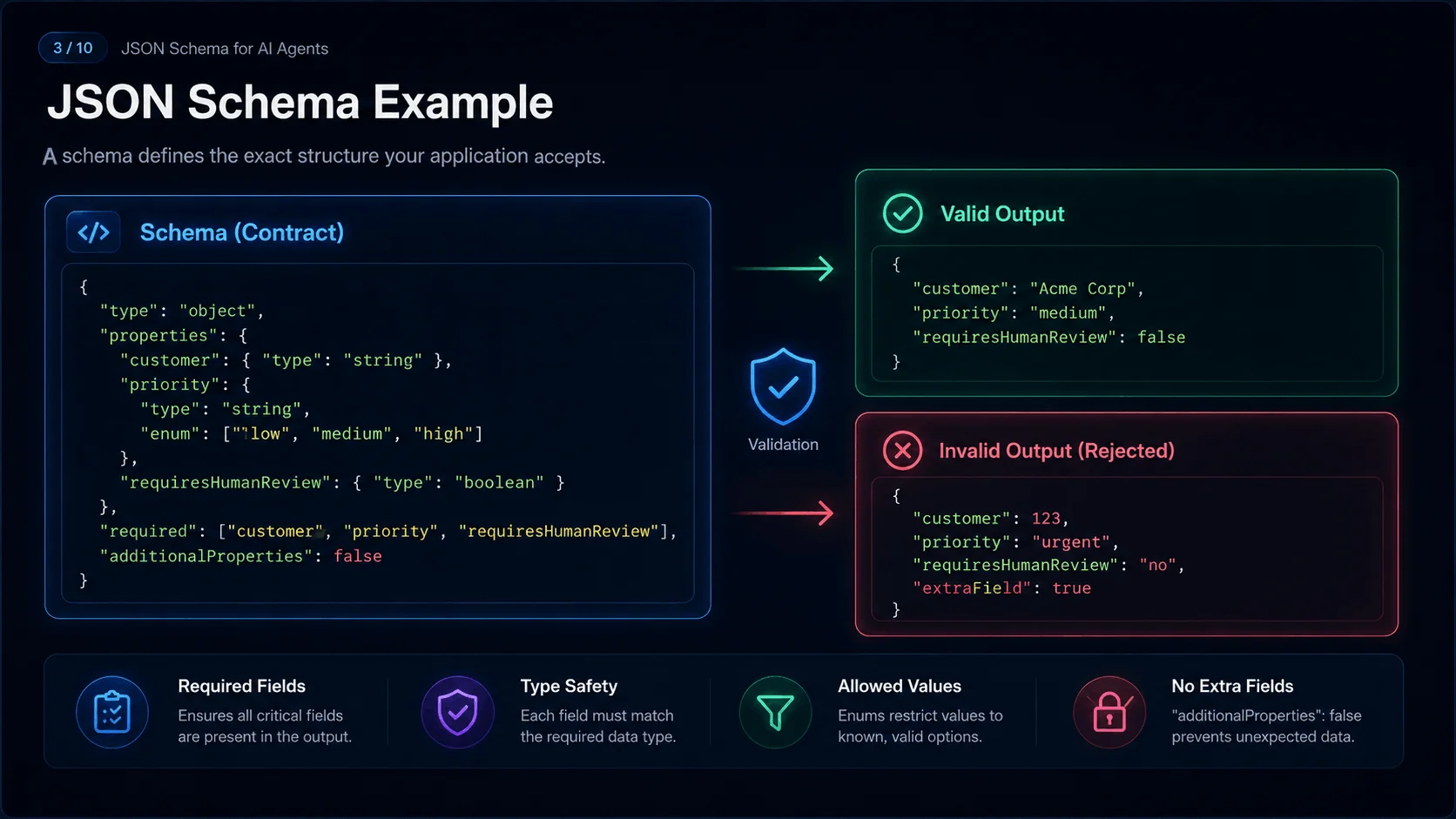
JSON Schema Example
{
  "type": "object",
  "properties": {
    "customer": { "type": "string" },
    "priority": { "type": "string", "enum": ["low", "medium", "high"] },
    "requiresHumanReview": { "type": "boolean" }
  },
  "required": ["customer", "priority", "requiresHumanReview"]
}
Why JSON Schema Matters More for AI Agents
Large language models are inherently probabilistic, meaning they predict the most likely next token based on training data. Traditional software, however, is deterministic—it expects specific inputs to produce specific outputs. JSON Schema acts as the critical bridge between these two worlds. For AI agents, a schema is not just a validation tool; it is a communication protocol that translates natural language intent into actionable, structured data that the rest of the application can handle safely.
Without a schema, an agent might decide to change a field name from "order_id" to "id" mid-conversation, or it might return a string when your database expects an integer. While these small deviations might seem trivial, they are the number one cause of runtime errors in AI-powered apps. By enforcing a schema, you ensure that the agent remains compatible with your existing codebase, regardless of how creative the model's internal reasoning becomes.
Structured Output vs “Return JSON”
Many developers start by simply adding "Return the results in JSON format" to their system prompt. While this works for simple demos, it is insufficient for production. "Return JSON" is a suggestion that the model can ignore or fail at if the context becomes too complex. In contrast, Structured Output is an API-level enforcement that uses the model's own probability weights to ensure compliance. It moves the responsibility of formatting away from the prompt and into the inference engine itself.
Using structured outputs also reduces the "token tax" of prompting. Instead of writing long paragraphs explaining how the JSON should look, you provide a compact schema. The model then uses its internal understanding of schemas to generate the correct format, leading to faster response times and lower costs, all while significantly increasing the reliability of the resulting data.
JSON Mode vs Structured Outputs
It is important to distinguish between "JSON Mode" and "Structured Outputs." JSON Mode, offered by many model providers, ensures that the output is syntactically valid JSON (e.g., no missing brackets). However, it does not guarantee that the JSON matches your specific schema. You could still get a perfectly valid JSON object that is missing half the fields you need. Structured Outputs go one step further by ensuring both the syntax and the internal structure are exactly as you defined them in your JSON Schema.
The AI Agent Reliability Problem
The primary barrier to deploying AI agents in high-stakes environments—like financial services or healthcare—is reliability. If a field name changes unexpectedly or a value is out of range, the entire workflow can halt, or worse, perform an incorrect action. Schemas solve this by acting as a "firewall" for your logic. They allow the agent to iterate and reason freely while ensuring that the final output is always safe to ingest into your production systems.
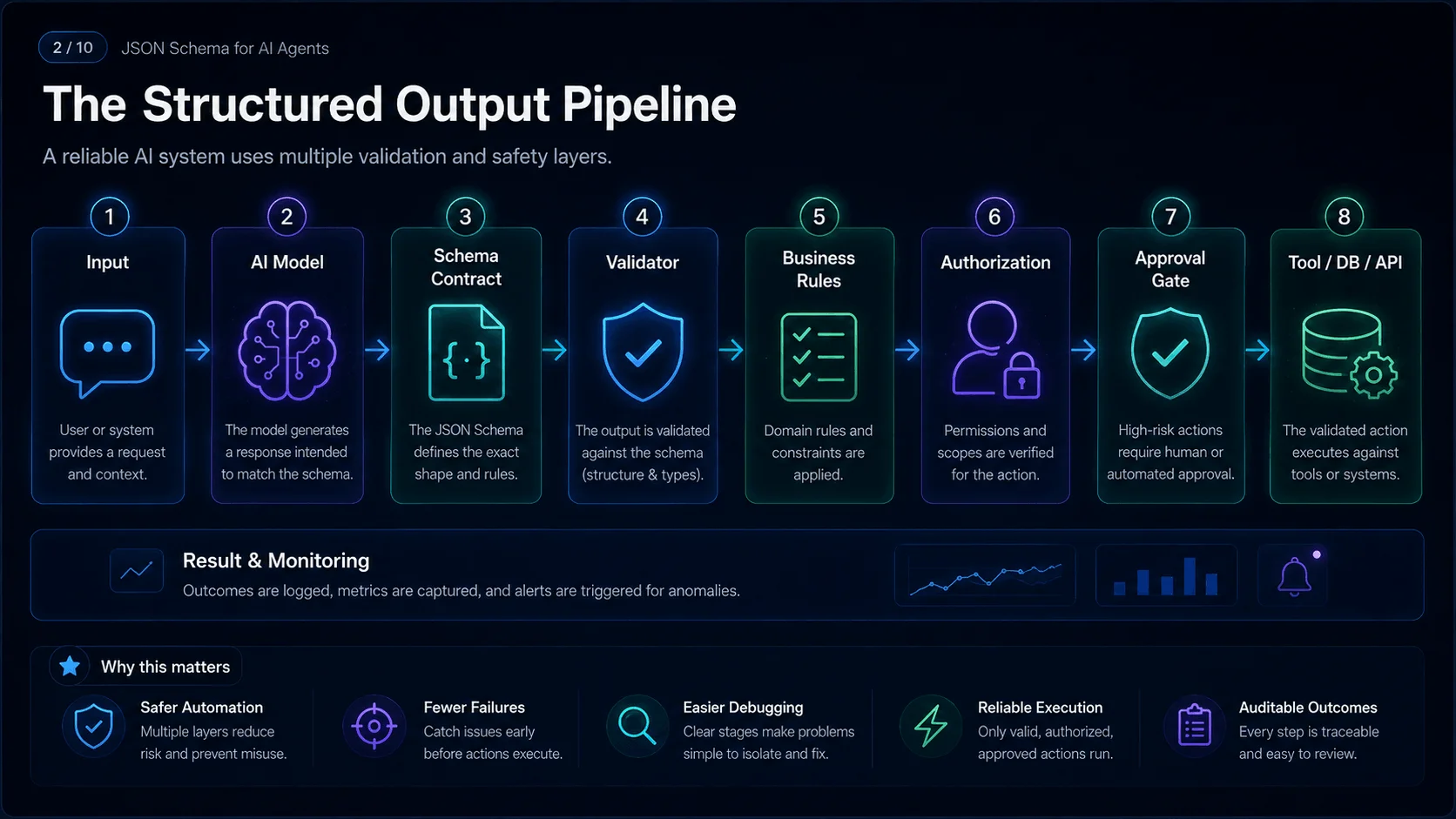
The Structured Output Pipeline
Building a reliable agent requires a multi-stage pipeline. The process starts with a user request, which the AI processes using its internal reasoning capabilities. Before the agent's decision is acted upon, it must pass through a structured output pipeline that includes schema validation, business logic verification, and potentially a human-in-the-loop review. This layered approach ensures that the "raw" AI output is refined into a "safe" application command before it ever touches your database or external APIs.
In a production environment, this pipeline also includes observability hooks. By logging where and why schema validations fail, developers can fine-tune their prompts or schemas to improve agent performance over time. This feedback loop is essential for moving from an experimental prototype to a stable, production-ready AI application that stakeholders can trust.
The Three Validation Layers of a Reliable AI System
A single schema validation is rarely enough for professional applications. A robust system employs three distinct layers of validation to ensure total safety:
- Structural Validation: This is the first gate. It ensures the JSON is syntactically correct and matches the defined schema types. If this fails, the request is rejected immediately, often triggering an automatic retry from the model.
- Business Validation: Once the structure is confirmed, the data is checked against dynamic business rules. For example, if an agent suggests a refund, this layer checks if the order amount matches the refund request and if the order is within the allowed return window.
- Authorization: The final layer confirms that the specific user who triggered the agent has the permissions to perform the requested action. This prevents the agent from being used as a vector for privilege escalation attacks.
Designing Good Schemas for AI Agents
Effective schema design is an art. Schemas for AI agents should be as narrow and explicit as possible. Avoid using generic "string" types when an "enum" of allowed values is available. The more specific you are, the less room the agent has to hallucinate. It is also a best practice to keep schemas focused on a single task—if an agent needs to perform multiple different actions, it is often better to use multiple specialized schemas rather than one giant, complex one.
Another key strategy is to provide descriptions for each property within the schema. Many model providers use these descriptions as additional context to help the agent understand what each field represents. Think of your schema as a set of instructions written in code; the clearer the instructions, the better the agent will perform.
Structured Outputs in Multi-Step Agents
In complex workflows where multiple agents work together, structured outputs serve as the "API contract" between them. When Agent A finishes its task, its output must be perfectly formatted so Agent B can ingest it without error. This creates a chain of trust throughout the entire system. In 2026, we see this most often in "research and report" agents, where a research agent gathers structured data points and passes them to a writing agent to generate a final document based strictly on those validated facts.
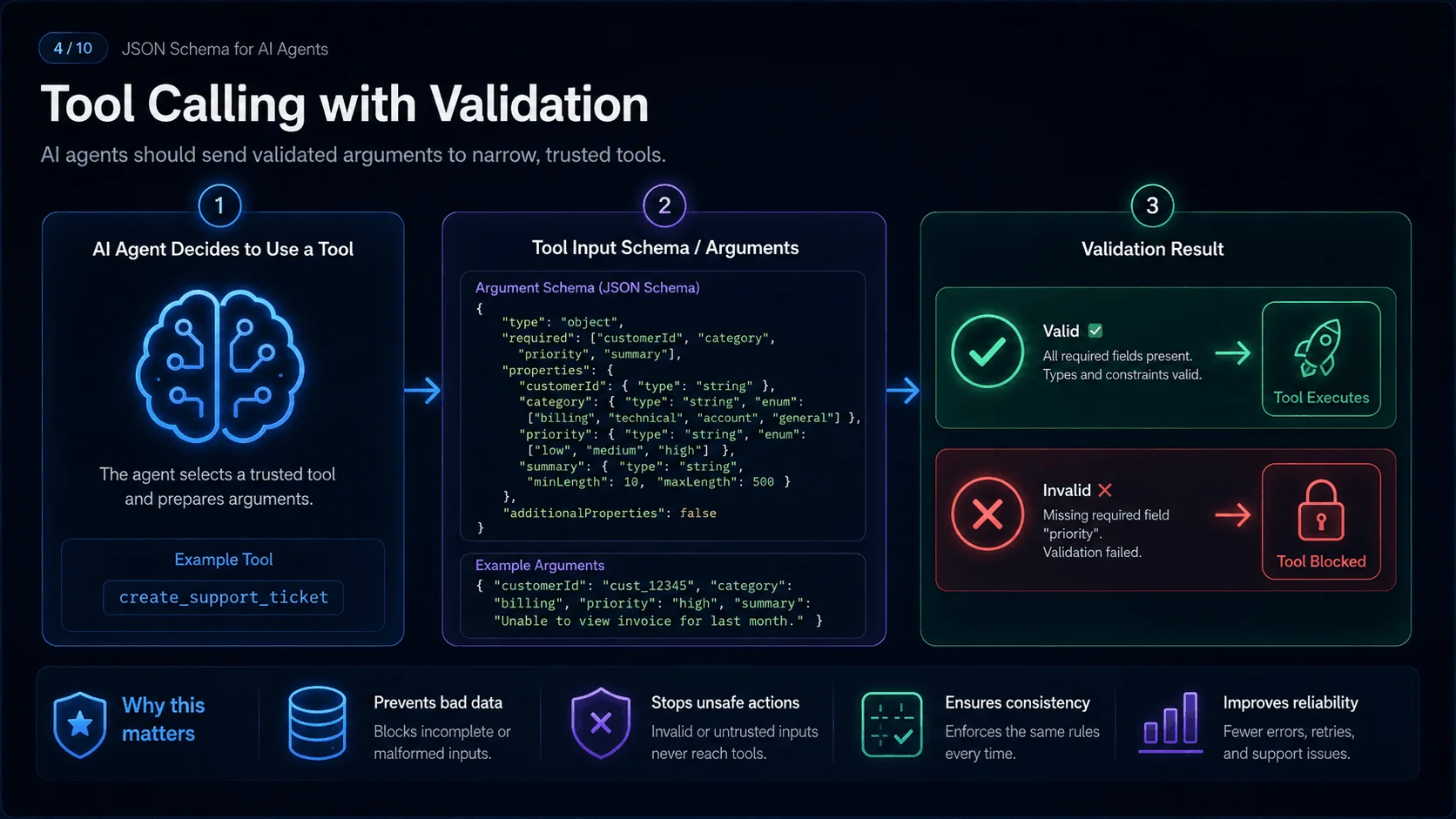
Tool Calling with Validation
Tool calling is perhaps the most powerful application of structured outputs. When an agent determines it needs to use an external tool—like a search engine or a CRM—it generates the arguments for that tool call. These arguments are then validated against the tool's specific input schema. This ensures that your backend services never receive malformed or malicious data from the AI, maintaining the integrity of your entire tech stack.
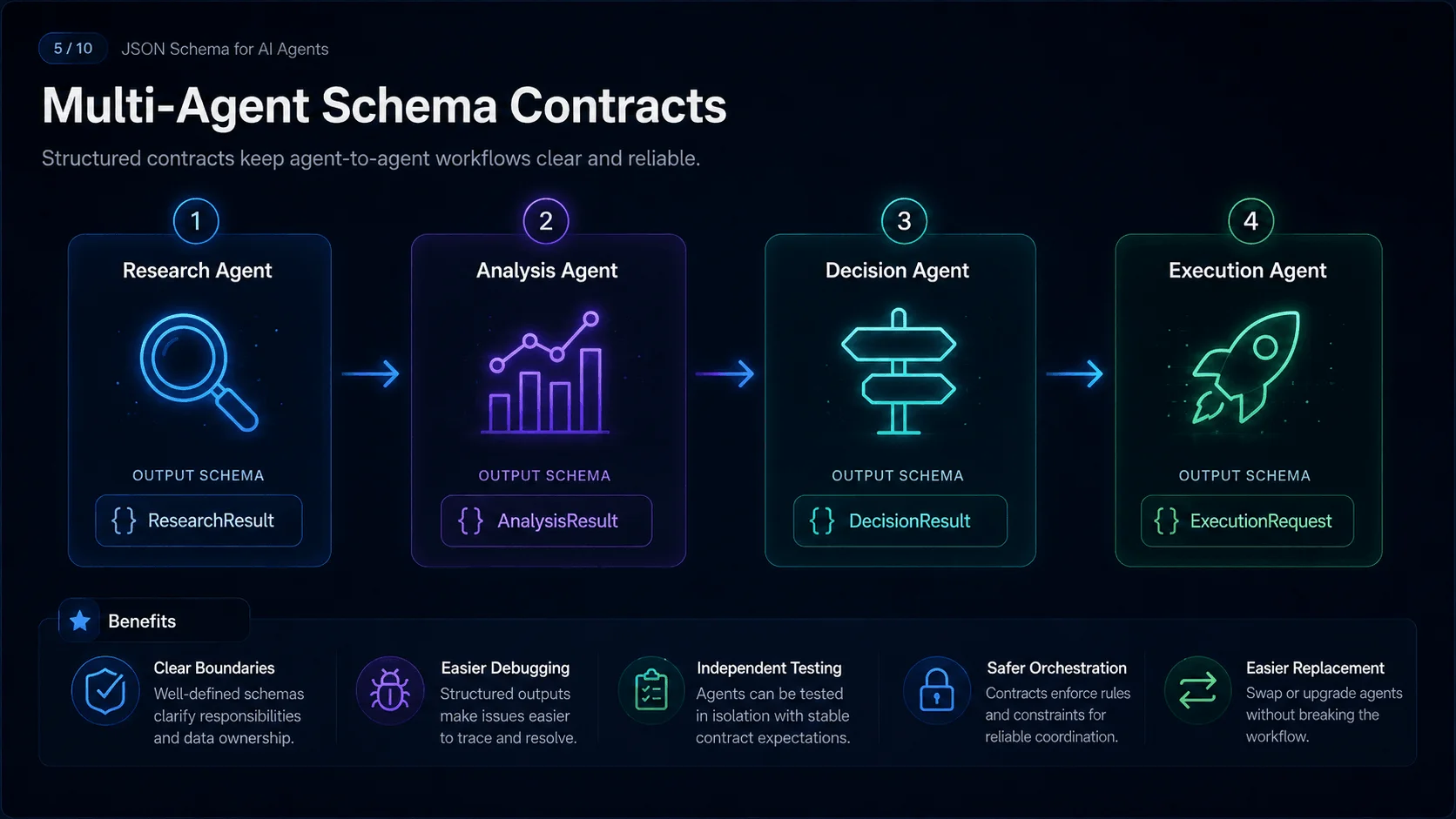
Multi-Agent Schema Contracts
As AI systems evolve into multi-agent swarms, the need for standardized communication becomes paramount. Multi-agent schema contracts define the inputs and outputs of every agent in the swarm, ensuring that data flow remains consistent even as individual agents are updated or replaced. These contracts allow developers to swap out an older model for a newer one without breaking the entire system, provided the new model continues to adhere to the established schema.
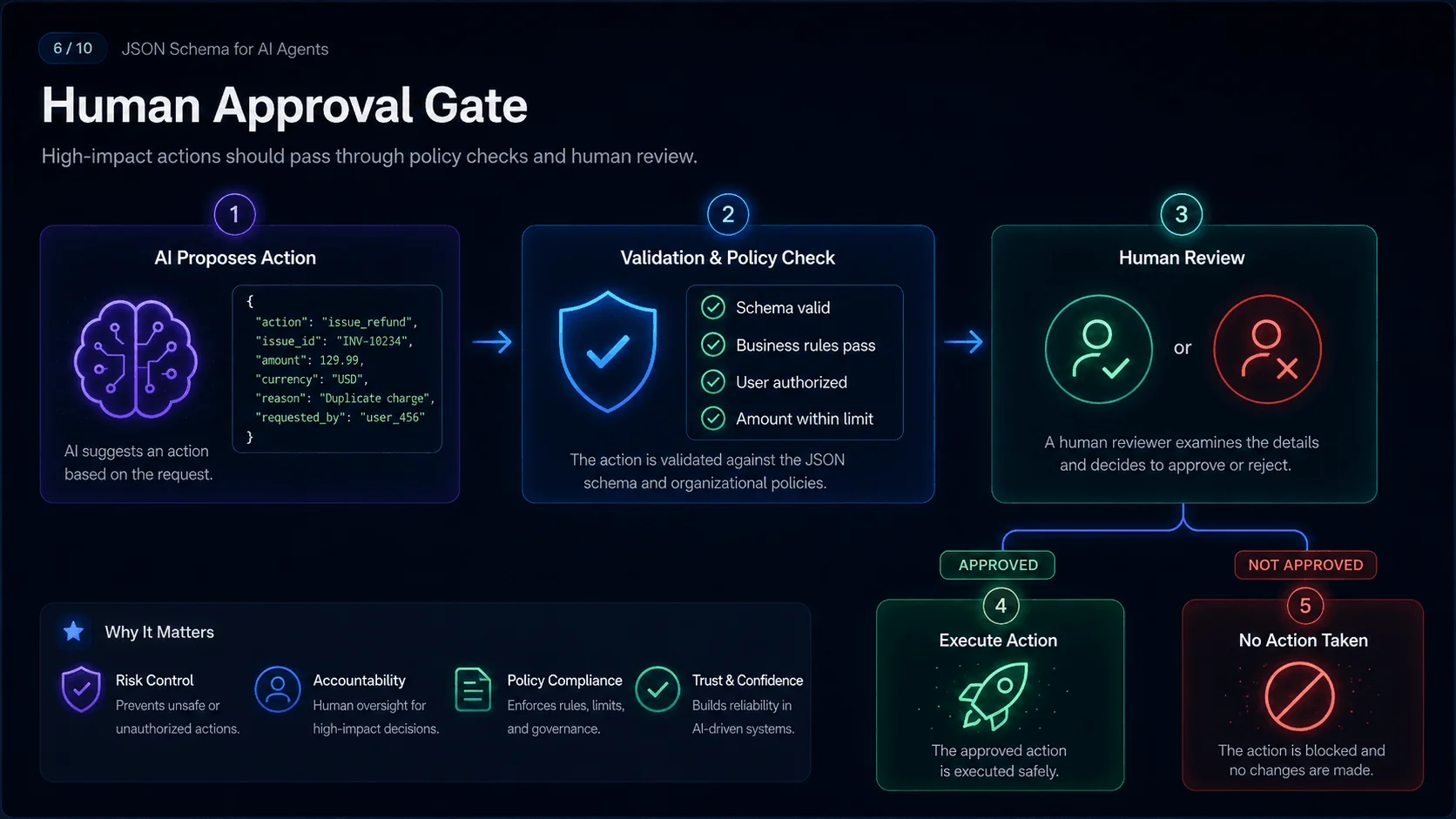
Human Approval Gate
While automation is the goal, some actions are too risky to leave entirely to an AI. Human approval gates integrate with structured outputs by presenting the validated data to a human reviewer in a clear, readable format. Because the data is already structured, we can generate dynamic UI components that highlight the most important fields for the reviewer, allowing them to make informed decisions quickly. This "cyborg" approach combines the speed of AI with the judgment of a human, creating a safer production environment.
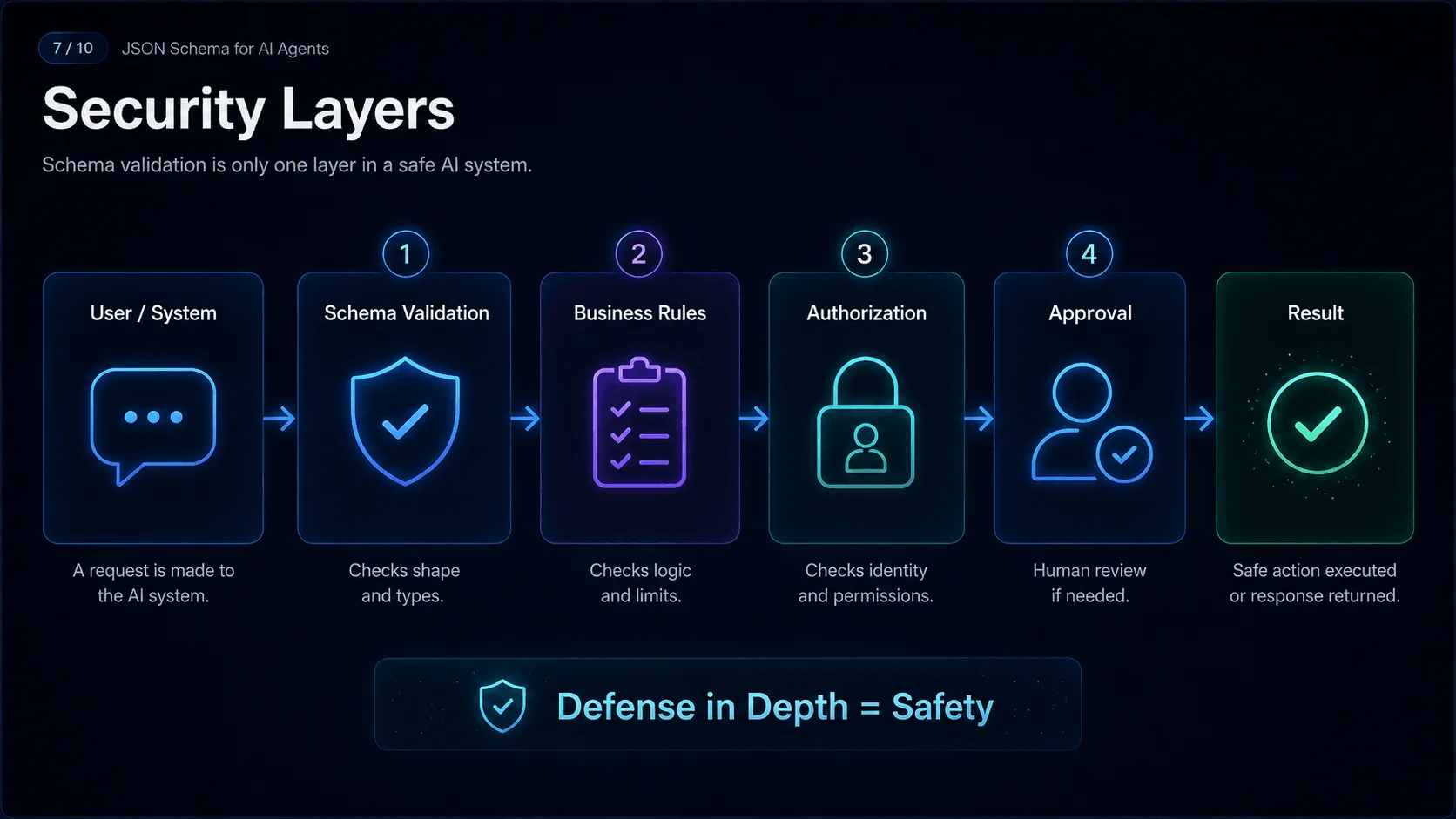
Security Layers
Security in the age of AI agents requires a defense-in-depth strategy. Schema validation is your first line of defense, but it must be backed by strict network policies, prompt injection filters, and traditional cybersecurity measures. By ensuring that every piece of data coming from the AI is validated against a schema, you significantly reduce the attack surface, making it much harder for a malicious actor to manipulate your system through prompt injection or other AI-specific vulnerabilities.
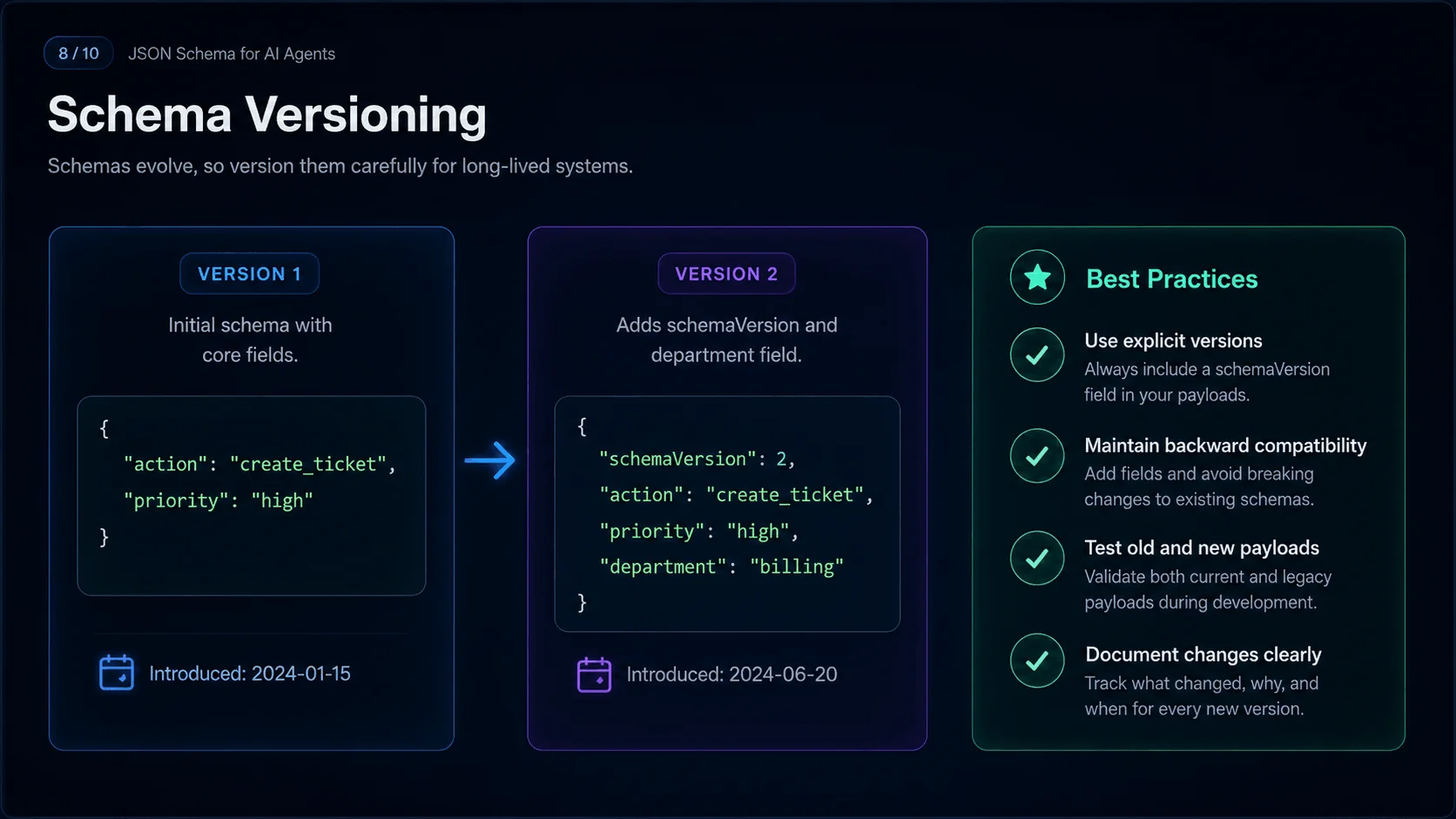
Schema Versioning
In a live production environment, your application will evolve, and your schemas must evolve with it. Schema versioning allows you to update an agent's capabilities while maintaining backward compatibility for existing users or long-running processes. By explicitly versioning your JSON Schemas, you can gradually roll out new features, perform A/B testing between different agent configurations, and ensure that your observability data remains consistent across different deployments.
Monitoring & Observability
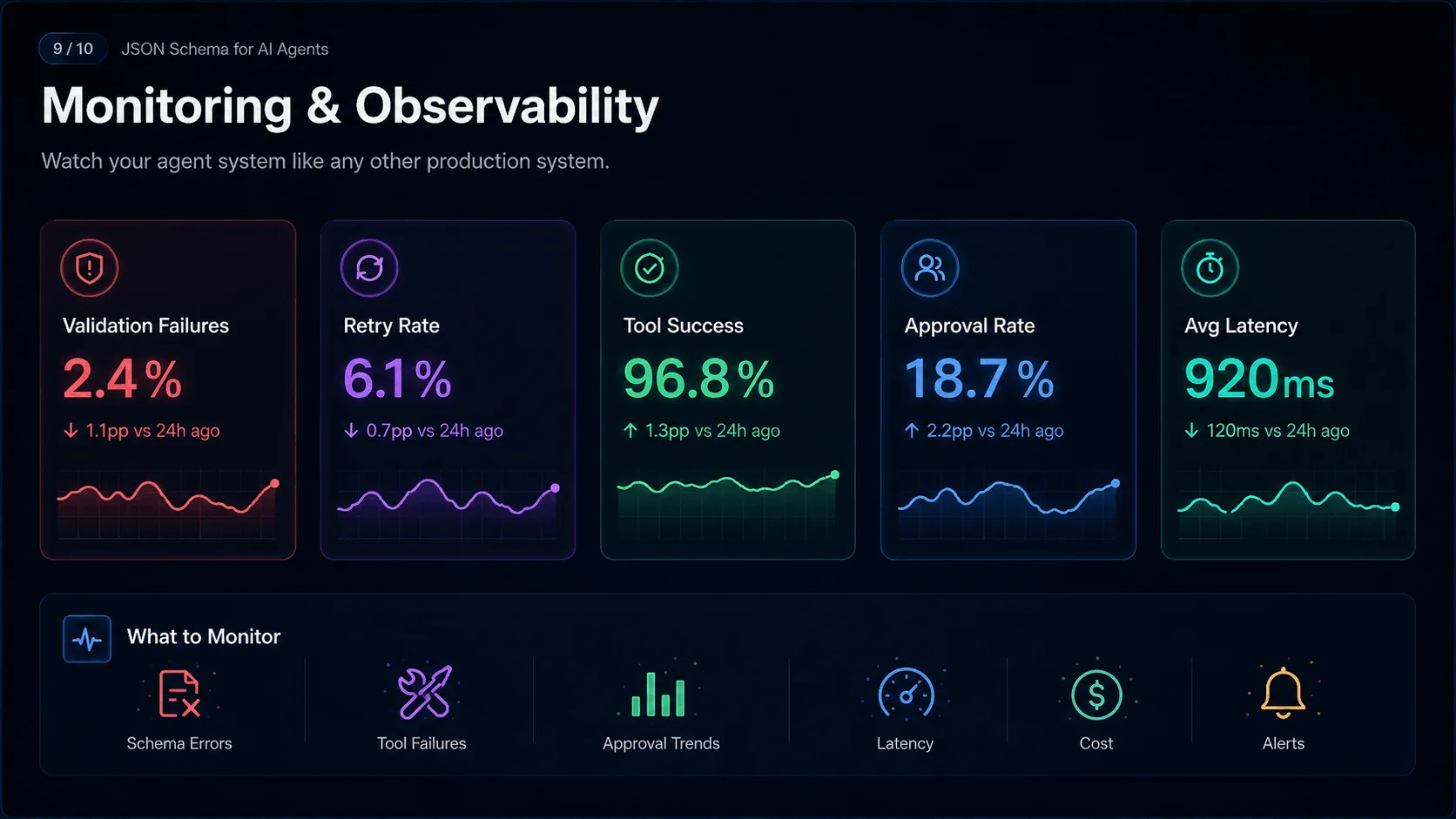
You cannot manage what you cannot measure. Real-time monitoring of schema validation performance is critical for identifying when an agent is struggling. If you see a sudden spike in validation failures, it may indicate a regression in model performance or a flaw in a recent prompt update. Advanced observability tools in 2026 allow developers to drill down into specific failures, viewing the exact input that caused the error and the model's attempted response, enabling rapid debugging and iteration.
Best Practices Checklist
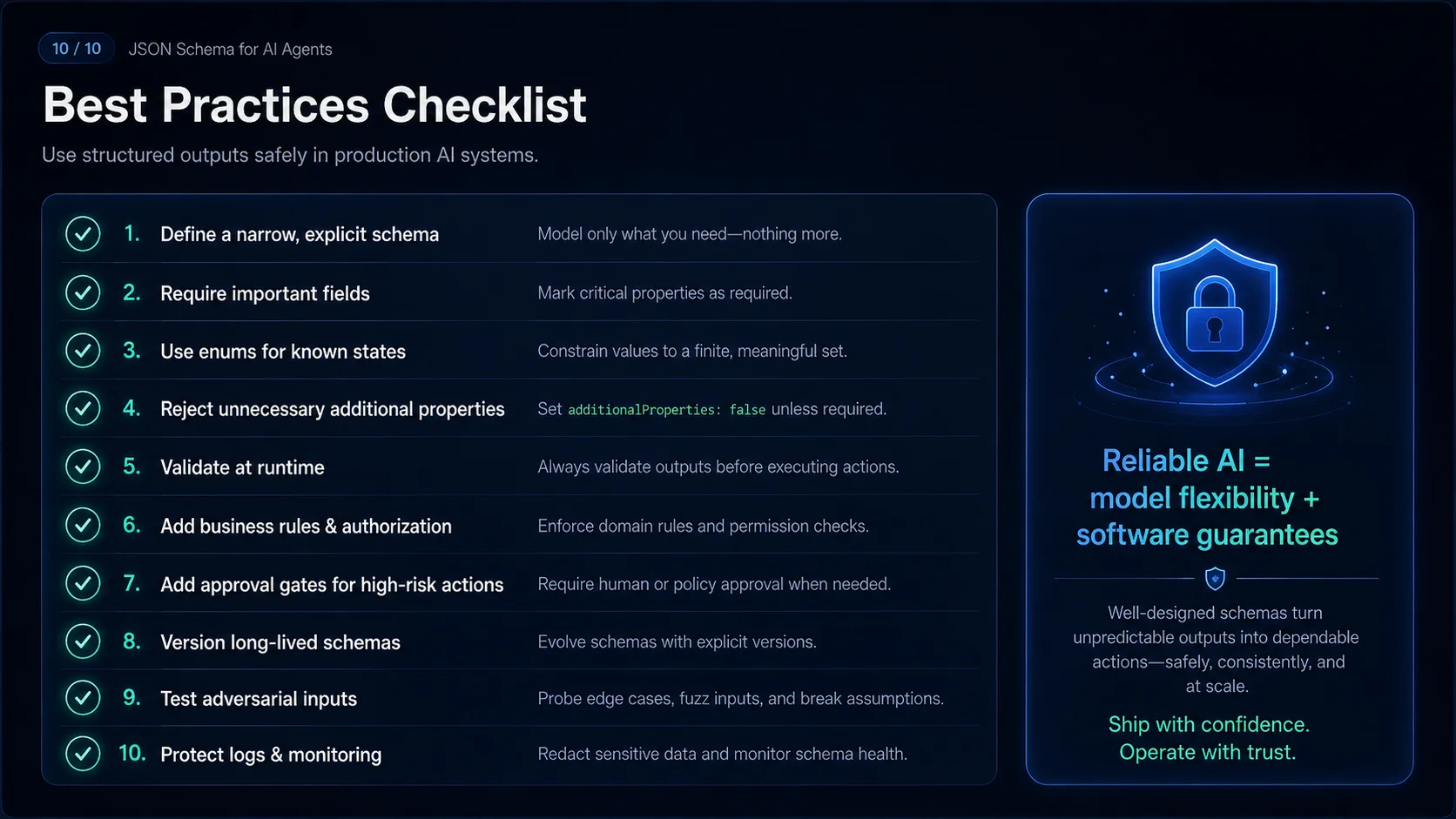
- 1Define narrow, explicit schemas
- 2Require all critical fields
- 3Use enums for fixed values
- 4Reject additional properties
- 5Always validate at runtime
- 6Apply business rules separately
- 7Use approval gates for risk
- 8Version your schemas
- 9Monitor schema health
- 10Protect sensitive data
Core AI Infrastructure
Structured output is no longer just a clever trick or a niche feature—it has become the core infrastructure of the modern AI era. As we move further into 2026, the distinction between "AI development" and "software development" continues to blur, with JSON Schema serving as the common language that unites them both. By implementing these rigorous validation patterns, you are not just building an app that works today; you are building a resilient, scalable AI architecture that will stand the test of time in the rapidly evolving landscape of autonomous agents.
The transition from experimental prototypes to mission-critical AI systems requires a commitment to reliability and safety. Structured outputs provide the necessary guardrails to make this transition possible. Whether you are building a simple customer service bot or a complex multi-agent orchestration platform, the principles of schema enforcement, business validation, and human-in-the-loop oversight will remain your most powerful tools for ensuring success in the real world.
Ready to build reliable AI agents?
I help startups implement structured AI architectures that scale.